|
|
Course description: Climate change is arguably the most pressing problem humanity faces today. What is climate change? What and who is responsible for it? What ought to be done? What is myrole in all of this? In this course we take the time to face these questions head-on and devote ourselves to making meaningful progress on them. Our approach is multi-faceted: we explore climate science and the nature of evidence for climate change, we consider the moralobstacles in addressing climate change and explore pathways for overcoming them, and we examine concrete responses to climate change on several scales. This approach will introduce us tosome distinctively philosophical views and methods from epistemologyand ethics. Wewill read challenging and exemplary works by living philosophers, work together to understand their arguments in class discussions, practice thinking and writing philosophically, and apply our conceptual efforts in our own lives by developing individual and collective climate action plans. |
|
|
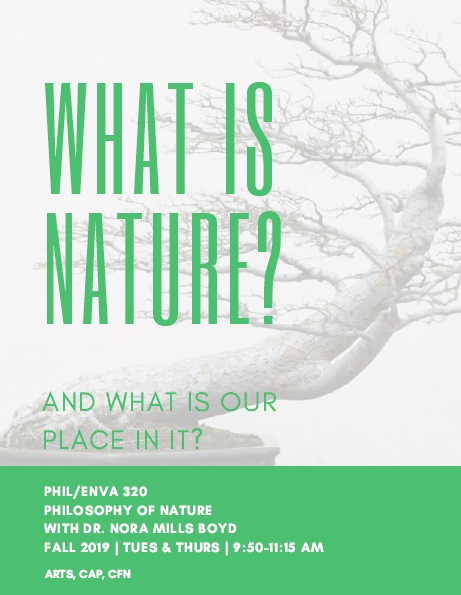
Course description:What is nature? And what is our place in it? We will take a long view on these questions, engaging with figures from Lucretius to Alexander von Humboldt to cutting-edge contemporary thinkers and activists. Along the way, we will analyze several important and notoriously tricky conceptual loci such as naturalness, wilderness, dominion, stewardship, the artificial, and the Anthropocene. Since our focus will be on humanity's relationship to the cosmos, this course will culminate in a final project where we create our own versions of the Voyager spacecraft golden records. Initial Course Syllabus, PHIL 320 Fall 2019 before class councils [pdf] Final Course Syllabus, PHIL 320 Fall 2019 after class councils [pdf] |

|
|
|
|
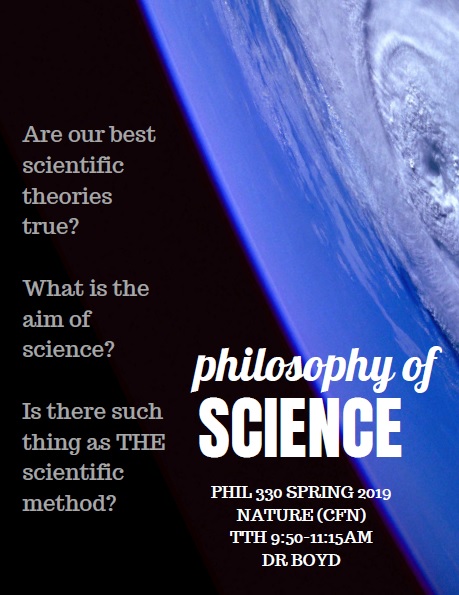
Course description:Are our best scientific theories true or merely provisionally adopted? What is the proper aim of scientific inquiry? Is there such thing as thescientific method? What makes science different that other human activities? In this course we will trace some of the historical trajectories that have led to the development of science as we know it today. We will get a taste for some of the most interesting problems that contemporary philosophers of science work on. Most importantly, this course will providestudents with the opportunity and tools to deepen their appreciation of the importance of nuanced and active public engagement with science. |
|
|
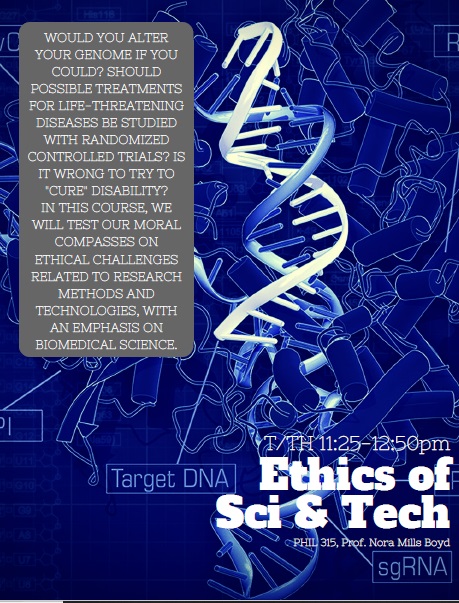
Course description:HERE |
|
Course description: Both in philosophy and in everyday life, we are often called on to give reasons for the claims that we make and we expect others to do the same. Ideally, this giving and taking of reasons happens through genuine dialog where each party stands to learn from the exchange. Sometimes however, reasoning and argumentation go awry and devolve into misunderstanding or dogmatic posturing. In this course we will practice essential skills for carefully identifying, crafting, and responding to arguments as well as explore ways to avoid pitfalls in reasoning and bad habits in argumentation. Students will have the opportunity to reason about topics that are matters of live controversy in the political climate of the United States today, and to practice listening to and respectfully responding to their peers with their own well-reasoned arguments. |
|
Tuesdays and Thursdays 12-3:15pm, Cathedral of Learning 221. Office hours (CL 901J): Tuesdays and Thursdays 11am-noon, and by appointment |
|
University course description: Ethical dilemmas in the practice of health care continue to proliferate and receive increasing attention from members of the health care profession, ethicists, policy makers, and the general public as health care consumers. In this course we will examine a number of ethical issues that arise in the context of contemporary medical practice and research by analyzing articles and decision scenarios. Topics to be covered typically include the physician-patient relationship; informed consent; medical experimentation; termination of treatment; genetics; reproductive technologies; euthanasia; resource allocation; and health care reform. Students who successfully complete this course will be able to identify and analyze different philosophical approaches to selected issues in medical ethics; have gained insight into how to read and critically interpret philosophical arguments; and have developed skills that will enable them to think clearly about ethical questions as future or current health care providers, policy makers, and consumers. This course is part of a core sequence leading to Certification in the Conceptual Foundations of Medicine Certificate Program, and is a companion course to HPS 0612 (Mind and Medicine) but may be taken independently. The course is of particular interest to pre-medical and pre-health care students. |
|
Thursdays 6-8:30pm, Cathedral of Learning 130. Office hours (CL 901J): Mondays 3-4pm, Thursdays 5-6pm, and by appointment |
|
University course description: This course is designed as an introduction to the philosophical issues that exist at the intersection of psychology and medicine. Among others, we will examine the following questions: What does it mean to be healthy? Can one define health and sickness purely objectively? Or does the notion of disease involve value judgments of various sorts? What does it mean to say that a disease is "genetic"? Are diseases always best explained by appealing to lower-level biological details such as genetics and biochemistry? What does it mean to biological "mechanisms" in explaining disease? Should human medical judgments (e.g., clinicians' judgments) be replaced by purely automatic computerized procedures? Are medical judgments influenced by various biases and can these biases be overcome? Are psychiatric disorders real? How should Scientists best explain psychiatric disorders? Can evolutionary biology be useful to psychiatry? The goal of this class is to provide students with a critical understanding of these philosophical issues. Previous knowledge of biology, psychology, and medicine is not needed for this class. Key notions and theories in these fields will be introduced progressively. Prerequisites: There are no formal prerequisites for this course. This course is part of a core sequence leading to certification in the Conceptual Foundations of Medicine Program, and is a companion course to HPS 0613 (Morality and Medicine) but may be taken independently. This course is of particular interest to pre-medical and pre-health care students. |
|
Thursdays 6-8:30pm, Cathedral of Learning 149. Office hours (CL 901J): Mondays 1-2pm, Thursdays 5-6pm, and by appointment |
|
University course description: Ethical dilemmas in the practice of health care continue to proliferate and receive increasing attention from members of the health care profession, ethicists, policy makers, and the general public as health care consumers. In this course we will examine a number of ethical issues that arise in the context of contemporary medical practice and research by analyzing articles and decision scenarios. Topics to be covered typically include the physician-patient relationship; informed consent; medical experimentation; termination of treatment; genetics; reproductive technologies; euthanasia; resource allocation; and health care reform. Students who successfully complete this course will be able to identify and analyze different philosophical approaches to selected issues in medical ethics; have gained insight into how to read and critically interpret philosophical arguments; and have developed skills that will enable them to think clearly about ethical questions as future or current health care providers, policy makers, and consumers. This course is part of a core sequence leading to Certification in the Conceptual Foundations of Medicine Certificate Program, and is a companion course to HPS 0612 (Mind and Medicine) but may be taken independently. The course is of particular interest to pre-medical and pre-health care students. |
|
Tuesdays and Thursdays 4-5:15 pm, Cathedral of Learning 116 Office hours (CL 901J): Tuesdays and Thursdays 3-4pm, and by appointment Required text: Merchant, Carolyn. 2007. American Environmental History: An Introduction. Columbia University Press. |
|
University course description: The goal of this course is to promote clear and rigorous thinking about environmental issues, both global and local, such as climate change, biodiversity, land management, and resource extraction. Of central importance to many such issues is the concept of "naturalness". As a result, cogent responses to environmental issues depend crucially on being able to evaluate both subtle scientific and philosophical arguments. We aim to help students develop the skills needed to find the best available information on environmental issues, and to make informed and philosophically sophisticated judgments about what conclusions-and what actions-are warranted on the basis of that information. |
|
Mondays 6-8:30 pm, Cathedral of Learning 313 Office hours (CL 901J): Thursdays 11-noon, 1-2pm, and by appointment Required text: Gimbel, Steven. 2011. Exploring the Scientific Method: Cases and Questions. Chicago: University of Chicago Press. |
|
University course description: The course will provide students with elementary logic skills and an understanding of scientific arguments. Ours is an increasingly scientific and technical society. In both our personal life decisions and in our work we are daily confronted by scientific results which influence what we do and how we do it. Basic skills in analyzing the structure of arguments in terms of truth and evidence are required to make this type of information accessible and useful. We hear, for example, that drinking alcoholic beverages reduces the chances of heart disease. We might well ask what sorts of tests were done to reach this conclusion and do the tests really justify the claim? We read that certain geographical configurations in South America "prove" that this planet was visited by aliens from outer space. Does this argument differ from other, accepted scientific arguments? This course is designed to aid the student in making sense of a variety of elementary logic skills in conjunction with the application of those skills to actual cases. |