Chapter 5
Light (and Matter!)
Created by John P. Cummings
Light
Wave or Particle?
Debate about nature of light goes back centuries, most famously to Newton and Huygens.
- Newton thought light was composed of particles.
- Huygens thought light was composed of waves.
Newton
Isaac Newton knew (or thought!):
- that light traveled in straight lines.
- that light traveled in a vacuum, and waves as known at the time required a medium to propagate.
- that shadows had sharp edges. (no diffraction)
Christian Huygens
Huygens proposed a wave theory of light in 1678
- big success was partial reflection at boundary; corpuscular model proposed particles "fits" at boundary.
- lacked experimental technology to test further.
Thomas Young (1801) sees interference of light
What is interference? - example of water
Young's two-slit experiment
Young shone light through two closely spaces slits

and saw an pattern that looked similar to this

Compare with ripple tank:

Light seems to be a wave!
Waves

Some properties of a "snapshot of a wave."
Waves


Relationship between wavelength and frequency and velocity.
Newton got the model wrong (maybe... see photons!) , but

Newtons first showed that white light is made up of many colored components.
Newton split light into colors

Newtons drawing of his experiment in his dormroom at Cambridge
Light - Electromagnetic Waves

Light was shown to be an electromagnetic wave by James Clerk Maxwell in 1861.
Light - Electromagnetic Waves
If you are a geek, you get his equations on a t-shirt.

Light - Electromagnetic Waves
If you are really a geek, you get a tattoo of his equations.

Wave - Electromagnetic Spectrum
The colors of the spectrum correspond to different frequencies of electromagnetic waves. The range of frequencies of electromagnetic waves goes beyond the narrow spectrum observed by Newton.
These waves all propagate through empty space at the same speed always, known as the speed of light, c.

Wave - Electromagnetic Spectrum

Particle again!- Photons
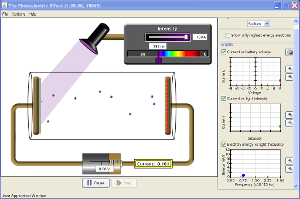
In the early 20th century, the development of Quantum Mechanics showed that light actually behaves as a particle with wave properties (I know, odd, right?). Einstein explained the ejection of electrons from metals by light with photons, tiny packets of light with energy proportional to their frequency. Many experiments have counted photons individually in low intensity light beams.
Newton was on the right track after all! (maybe)
The Photoelectric effect

Matter
The matter that makes up the universe can be categorized into chemical elements. Each element is a different type of atom and their properties allow them to be arranged into the periodic table.

Atoms
Atoms are made from protons (+ charge), neutrons (no charge), and electrons (- charge).

A cartoon of an atom. Protons and neutrons make a nucleus, surrounded by electrons.
Atoms
Atoms are made from protons, neutrons, and electrons.

A more "realistic" picture of an atoms density clouds
Atoms, protons, neutrons, electrons
- An atoms properties depend on the charge of it's nucleus: neutrons don't matter much!
- Number of protons is called atomic number and determines spot in periodic table.
- Number of protons and neutrons is called atomic mass number.
Elements and Isotopes
A given species of atom (same number of protons) may have different atomic mass numbers (different number of neutrons). These are called different isotopes of the element. For instance, carbons chemical properties are determined by its atomic number 6, but it is found in nature as many isotopes, with 6, 7, and 8 neutrons, for example. This gives atomic mass numbers of 12, 13, and 14, which we write 12C, 13C, and 14C. Isotopes with extra neutrons are often unstable and will decay radioactively.
molecules
Atoms can combine in many many ways to form molecules. The bind electrically to make compounds such as water (H20) and sucrose (C12H22O11)Matter/Light interactions
Emission
Matter can emit light in various ways. For instance a light bulb emits visible light.
Absorption

Solar panels absorb as much light as they can. They are usually black for this reason (why?)
Transmission
Light passing through a material is called transmission.
The amount of transmission may be different at different wavelengths.
Reflection/scattering
If light bounces back from matter, it is called reflection or scattering.
Two (or three) types of spectra
If we record the intensity of light we detect from an object at different wavelengths, we notice some distinctly different types of distributions.
- continuous spectra
- line spectra
Spectra Types
Sometimes we see a smooth, uninterrupted distribution, like from a light bulb.
And sometimes we see lines, either emission or absorbtion.
Line spectra
The lines in the spectra we detect are due to the electron energy levels in an atom. The electrons bound to an atom have only a few discrete allowed energies. They emit or absorb light only when it has the energy corresponding to an allowed change of electron energy levels.

Emission line spectra
Every atom or compound will have a unique set of electron energy levels determined by quantum mechanics. If a gas is heated, we see emission lines corresponding to energy level differences. Spectra are: Argon, Helium, Hydrogen, and Mercury.

Absorption line spectra
If a continuous spectra passes through a cool gas, certain energy photons are absorbed.

The dark lines in this solar spectrum tell us what gasses are in the sun's upper atmosphere.
Continuous Spectra
Continuous spectra emit light due to atomic transitions also, but the atoms are not independent as in a gas and the quantum levels appear to be continuous. The emission spectrum has a peaked shape follows two laws.- The Stefan-Boltzmann law: The energy per unit area emitted by a blackbody is proportional to the temperature to the fourth power.

- Wein's law: The wavelength of the peak in the emitted spectrum is inversely proportional to the temperature.

Blackbody Spectra

Doppler shift
The Doppler shift for sound


Summary
Details of the spectra can provide us with a wealth of information: the composition, temperature and motion of the object we are looking at, regardless of the fact that it may be many light years away!Telescopes
The instruments used to collect light by astronomers are called telescope
What does a telescope do?
Magnification?
Magnification might seem important (and it can be) but often it doesn't help.

These are angular sizes: 1 degree is 60 minutes (of arc) or 60', and one minute is 60 seconds (of arc) or 60".
Even the "Largest" (angular size) star, Betelgeuse, has an angular size 0.055".
Planets show structure


Stars are still points

.jpg)
Even giant Betelgeuse

600 ly away.
Faint objects often large
Like the Andromeda galaxy
which might look small (to your eye).
but it is actually 4 or 5 full moons across!

it is just very dim
Light collecting area
- we just need to collect as much light as possible. Think of your eye in the dark!
- The larger the diameter the more light collected.
- The important number is the area of the opening,

- doubling the diameter of a telescope increases the area by a factor of four!
Angular resolution (resolving power)

The angular resolution or resolving power is the ability of an instrument to distinguish two very close point sources.
The theoretical limit (in radians) is given by  .
The human eye has a resolution of about 1' while the HST has a resolution of about 0.05".

both 2.5 m telescopes
Types of Telescopes
Telescopes can be broadly categorized into two basic types: refracting and reflecting telescopes.- refraction if the effect of bending of light as it passes between regions of differing optical "densities"
- reflection is the bouncing of light from a surface such as a mirror.
Refracting Telescopes

Yerkes Observatory
Largest refractor ever built, in 1897, had a 40" lens, which must be supported only at edges.
Reflecting Telescopes

Popular amateur telescope
Simple, easy to make.

Also popular with pros
Keck observatory, Mauna Kea, Hawaii.

But a little bigger
10 meter segmented mirror!

Telescopes detect different wavelengths
The non-visible parts of the spectrum contain much useful information also
- Planets emit (blackbody) mostly in IR
- Hot stars emit in the UV and X-ray
- Gamma rays are emitted from very violent events such as the explosion (supernova) of some stars.
- Many object emit in the radio region of the spectrum.
Radio telescopes
They may not look like a "telescope"

Arecibo, 305 m, worlds largest single aperture telescope.
Observing different wavelengths
Different information about the same object can be learned by observing it in many regions of the spectrum

M1, the Crab nebula in Taurus.
Problems with Earth-bound viewing
There are many problems with earth-bound observations due to the atmosphere. Some of these problems we have lessened the impact of with technology, but some we simply must go to space to avoid.
Weather
The weather can be a problem for viewing (like in Albany!)

Site selection for a scope can help a lot.
Brightness of Daytime sky
On earth you can only observe during the night, since the light scattering off the atmosphere is so bright.

In space it is always dark, except looking right at the sun.
Light pollution
Even at night on earth, city lights have blocked the night sky in many areas

Mt Wilson observatory now blinded by Los Angeles
Distortion due to turbulence
Adaptive optics
We can correct for distortion with adaptive optics such as Keck's segmented mirrors

Atmospheric Absorption
One "unfixable" problem at certain wavelengths is the absorption by the atmosphere

to solve this problem we must move our telescopes beyond the atmosphere.